CANA: The first state association of nurse anesthetists in the nation
Born of a legal fight over the right of nurses to give anesthesia, CANA has served as the voice of California's nurse anesthesiologists for more than nine decades.
From the Discovery of Anesthesia to a California Supreme Court Victory
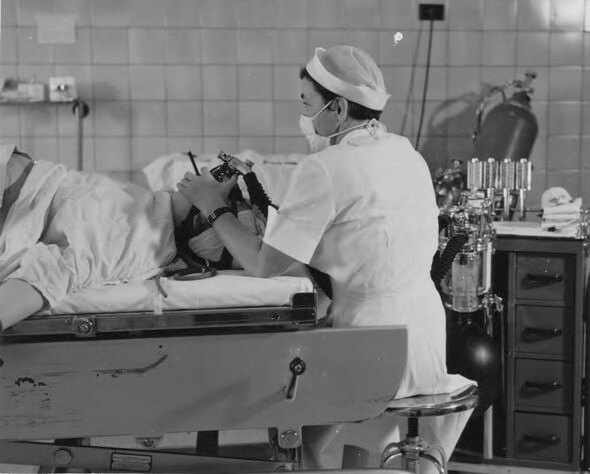
Surgical anesthesia, first demonstrated in 1846, is widely regarded as nineteenth-century America’s greatest gift to medicine. Paired with the rise of professional nursing and the principles of asepsis, it opened the door to modern surgery — but only once it could be given safely. Early anesthetics were often administered by medical students more interested in watching the operation than in the patient breathing under the mask, and deaths from asphyxiation followed. Surgeons needed anesthetists whose sole devotion was the patient’s safety. Nurses — intelligent, vigilant, and focused entirely on the patient — proved ideally suited to the work, and in the 1880s the first advanced nursing specialty, nurse anesthesia, was born.
California produced early pioneers of its own. Alta Alice Miner Bates — the namesake of the Berkeley hospital — opened her own sanatorium for women and infants in 1905, serving as its administrator, chief anesthetist, and director of its nurse training program. Over a career spanning more than fifteen years, she administered upwards of 14,000 anesthetics.
As nurses established themselves in anesthesia in the early twentieth century, organized opposition arose from physician anesthetists — and California became the principal battleground. In 1928, Adeline Curtis, a nurse anesthetist practicing at the Johnson-Wickett Clinic in Anaheim since 1921, received a letter from the state Board of Medicine accusing her of practicing anesthesia illegally. She spent years, and her life savings, fighting back. Her persistence produced a 1933 opinion by Attorney General Ulysses S. Webb confirming that no California law barred nurses from administering anesthetics, and the controversy ultimately led to a California Supreme Court decision affirming that anesthesia is part of the practice of nursing.
Curtis carried the warning up and down the state — and out of that campaign, in 1931, thirteen charter members founded the California Association of Nurse Anesthesiology: the first state association of its kind in the country.
Sophie Gran Winton, a nurse anesthetist decorated for her service in France during the First World War, was installed as CANA’s first president. In 1935 the association affiliated with the newly formed National Association of Nurse Anesthetists — today the American Association of Nurse Anesthesiology (AANA). Membership grew from those thirteen founders to roughly five hundred in the 1950s, stabilizing near one thousand through the 1970s. Since then, the association has grown substantially, with over three thousand nurse anesthetists now practicing in the state.
Through decades of educational meetings, a widely read bulletin, and sustained advocacy in Sacramento and Washington, D.C., CANA has helped secure the independent, respected scope of practice that California CRNAs hold today — and has kept nurse anesthesiologists at the center of the answer to the state’s and the nation’s health care needs.
1846: Surgical anesthesia is discovered
Recognized as the greatest American contribution to nineteenth-century medicine, it makes modern surgery possible.
1880s: Nurse anesthesia becomes the first advanced nursing specialty
Beginning in the northeastern United States and flourishing in the Midwest, the specialty is established nationwide within a decade.
1905: Alta Alice Miner Bates opens her sanatorium
The pioneering Berkeley anesthetist serves as administrator, chief anesthetist, and nursing educator, delivering more than 14,000 anesthetics in her career.
1928: Adeline Curtis is told her practice is illegal
A letter from the California Board of Medicine sets off a years-long fight that will define the profession's legal standing in the state.
1931: CANA is founded — the first state association in the nation
Thirteen charter members organize, with decorated WWI nurse anesthetist Sophie Gran Winton as first president.
1933: The Attorney General sides with nurse anesthetists
Ulysses S. Webb's opinion confirms no California law forbids nurses from administering anesthetics; the courts later affirm anesthesia as part of nursing practice.
1935: CANA affiliates with the national association
The National Association of Nurse Anesthetists — forerunner of today's AANA — welcomes California as an affiliate.
1950s-70s: Membership grows to roughly one thousand
Regular educational meetings, a widely read bulletin, and legislative work in Sacramento and Washington, D.C. build the association's influence.
Today: The voice of California's CRNAs
California nurse anesthesiologists practice with an independent, respected scope — an essential part of the answer to the state's health care needs.
Further Reading
Past Presidents of CANA
From Sophie Winton in 1931 to the present day. Select an era to view its presidents.
The Modern Association (2007-Present)















Chris Stein 2006
Fred Cardinal 2005
Jennifer Woolley 2004
Joseph Burkard 2003
Evan Koch 2002
Chris Stein 2001
Brent Sommer 2000
Deborah Haight 1999
Martin Lynch 1998
Cecil Vercillino 1997
Evan Koch 1996
Elizabeth Sodbinow 1995
Tom Baniak 1994